DePIN vs DeFi: What’s the Difference?
Understanding two big ideas shaping Web3.
While sounding similar, DeFi and DePIN represent two different parts of Web3. DeFi reimagines finance on the blockchain, while DePIN reimagines real-world infrastructure, letting communities build and maintain networks together.
Today we’ll take a look at each of these terms and go deeper into their differences.
DeFi: Finance without Banks
DeFi (decentralized finance) puts the power of money in your hands. No banks, no middlemen, just smart contracts on the blockchain automating transactions.
Take Aave as an example. You can deposit crypto, earn interest, or borrow assets automatically, without ever going through a traditional bank. Everything stays digital: your assets and managing accounts. DeFi changes the way we handle money since it doesn’t directly touch the physical world.
DePIN: Infrastructure Powered by Communities
DePIN (decentralized physical infrastructure networks) takes blockchain into the real world. Participants contribute hardware or resources, like routers, sensor data, and bandwidth, to support networks that everyone can use.
For example, Uplink lets people register their routers to strengthen connectivity in underserved areas. Participants earn rewards while helping expand a decentralized network. The more people join and ISPs that integrate, the stronger and more resilient the system becomes!
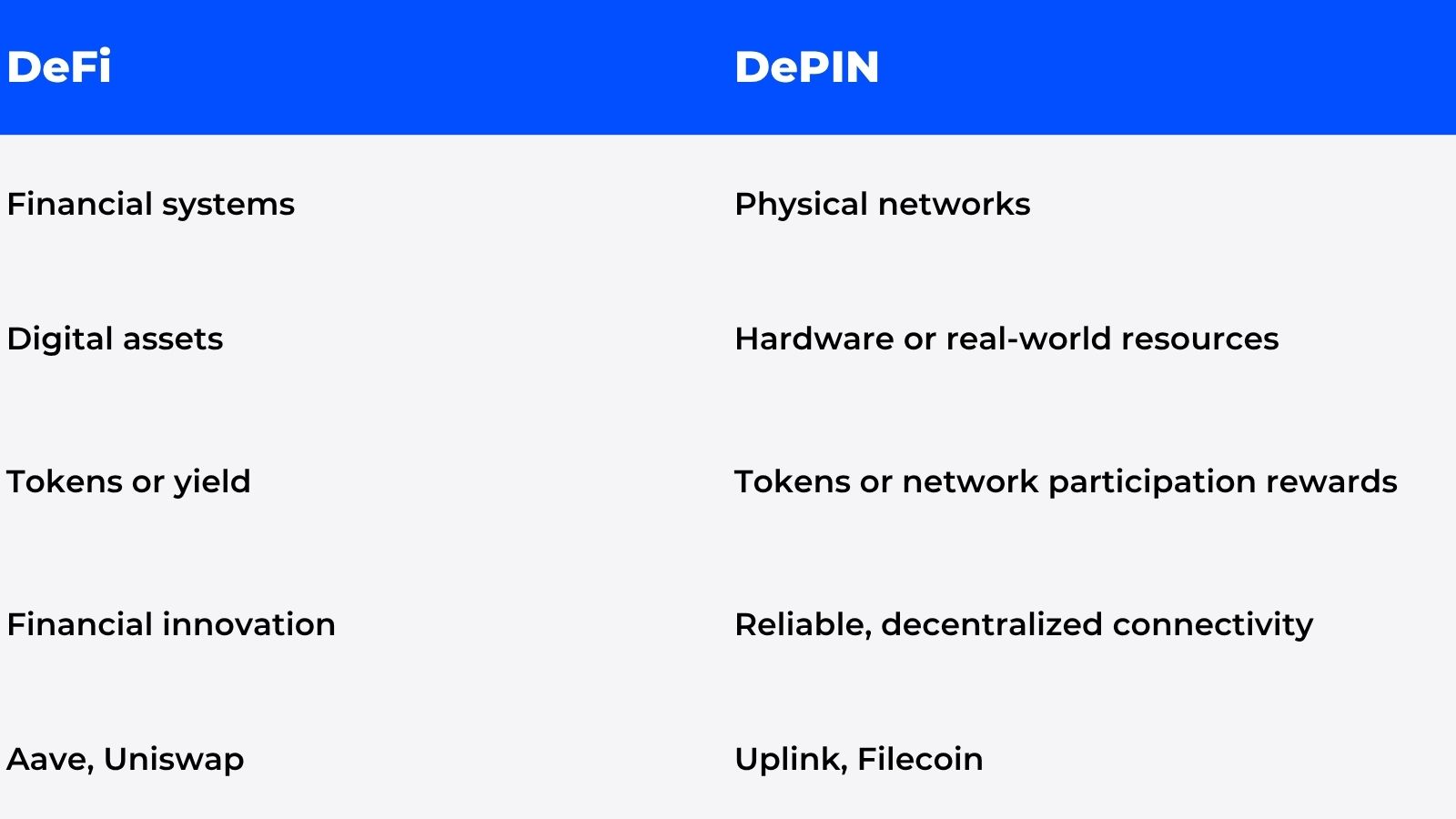
DeFi vs DePIN at a Glance
Two Sides of the Same Coin
DeFi and DePIN are both about decentralization, but in different ways. One transforms money. The other transforms infrastructure. Together, they show how blockchain can reshape both our digital and physical worlds.
Join the Network Revolution
You can be part of this change. Register your router with Uplink and help build a more reliable, decentralized internet. By joining, you can be part of our network and future testnet, you’ll support connectivity in your locality and earn rewards for powering connectivity!
Register your router on the Uplink App to be part of our initial testnet →
.jpg)

.jpg)